

Crafting the Ultimate Testing Framework for Athlete’s Physical Preparation
Introduction
In the complex domain of athletic development, the careful orchestration of an athlete’s physical conditioning is crucial. Evaluating essential physical traits like strength, agility, and endurance to pinpoint areas for enhancement is key, guiding the selection of appropriate training interventions and diagnostic evaluations.
The abundance of assessment tools elevates the complexity of choosing the most suitable tests, highlighting the need for a methodical strategy to identify the most relevant physical assessments. This underscores the importance of understanding test validity as a network of inferences, aiding professionals in making more confident and precise measurement choices. Despite the existing gaps in the literature regarding athlete assessment models, the latest publication on this subject published by a team of Australian scientists led by James, L. aimed to develop a modern validity-based framework to guide the selection of diagnostic measures. This framework aims to integrate technical, decision-making, and organizational factors for an improved approach to athlete preparation and performance betterment.
Validity
In the nuanced domain of sports science, the concept of validity stands paramount in the selection of performance tests, gauging the extent to which a measure accurately aligns with its intended objectives. Historically, discussions on validity were anchored around three core forms: content, criterion, and construct. Yet, the discourse has dramatically evolved over the past half-century, subsuming numerous interpretations and definitions along the way. Contemporary discourse has shifted towards a consolidated theory, favoring a return to the foundational validity types while concentrating on gathering evidence to substantiate or refute a test’s validity within specific scenarios.
In the arena of sports performance, determining a test’s relevance hinges on the sport in question and its performance nuances. For sports where outcomes are quantifiably measured—like times, weights, or distances—the application and assessment of criterion validity are relatively straightforward. An example being the correlation between barbell velocity during a power clean and competitive weightlifting prowess.
Contrastingly, sports characterized by complex, multifactorial outcomes—encompassing team and combat sports, for instance—pose a challenge to directly applying criterion validity for evaluating performance metrics. For these sports, content validity is pivotal, scrutinizing if a test battery aptly measures crucial physiological traits for sport performance. Yet, beyond identifying relevant physical attributes, it is vital to assess their impact on actual performance outcomes. Construct validity becomes invaluable here, establishing the relevance of specific physical qualities to sport performance through a series of logical inferences linking test scores to desired performance results. This approach offers a refined lens through which to evaluate the intricate interplay between physical competencies and sport-specific performance achievements.
Layers Of Validity
In the intricate dance of marrying physical preparation with competitive success, we embark on a journey through a realm of “validity layers,” a conceptual scaffold that aids us in navigating the often intricate and non-linear pathways connecting physical fitness metrics to the zenith of competitive achievement. This intellectual construct recognizes the challenging, sometimes Sisyphean task of tracing a straight line from a fitness benchmark, such as the maximum weight one can squat, directly to the laurels of victory in the competitive arena. The sport of rugby, with its tapestry of physical confrontations, offers a compelling tableau. Here, the raw power measured by a one-repetition maximum (1-RM) back squat might not directly translate to triumphs on the field. However, this prowess in strength could manifest as superior tackling abilities, a skill that significantly delineates the outcomes of higher echelon matches from their lower-tier counterparts. This nuanced approach, leveraging intermediate markers or proxies, allows us to construct a bridge of evidence linking the quantifiable aspects of physical readiness to the qualitative triumphs of competition. In the academic vernacular, these layers of evidence serve as a prism through which we can view the complex relationship between the robustness of an athlete and their prowess in the crucible of competition.
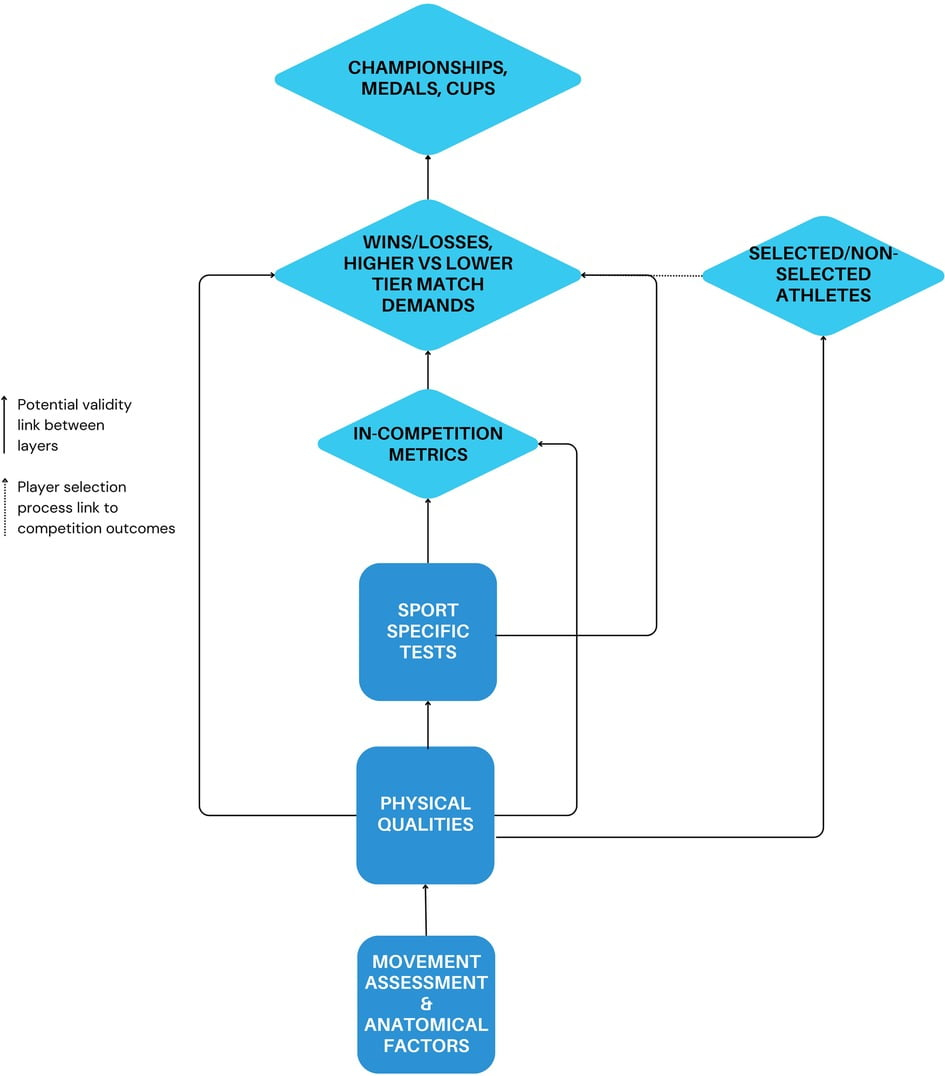
Figure 1
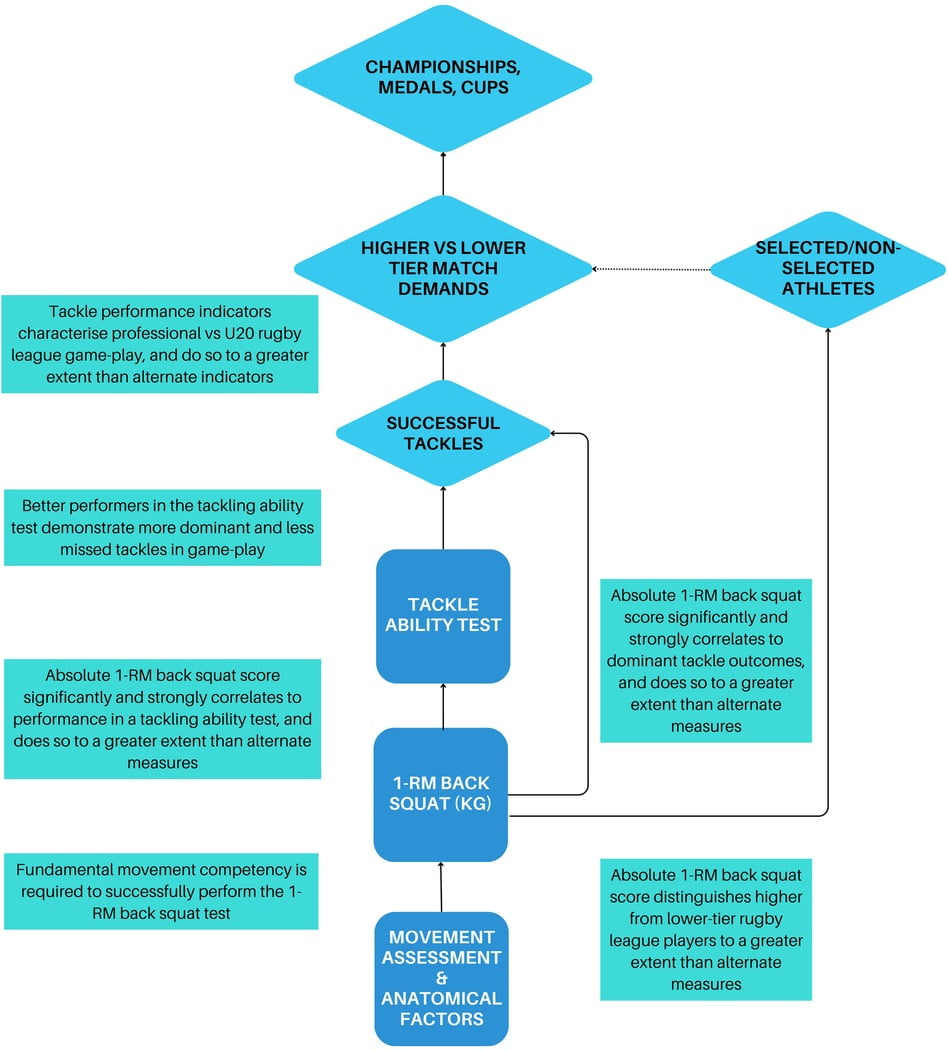
Figure 2
The endeavor of crafting layers of validity necessitates distilling the bond between physical metrics and competitive success into digestible, verifiable segments. Illustrating the legitimacy of these intermediary links bolsters the overarching validation of the construct in question, albeit indirectly. The narrative thickens with each additional step, enhancing both complexity and the breadth of evidential support. Such an approach not only maps out the intricate measure-to-performance journey but also frames a requisite blueprint for analyzing the seamlessness of these connections. This multi-tiered strategy, while context-dependent, fundamentally aims to unravel and elucidate the intricate tapestry of measurement and its impact on the field of play. Akin to assembling a puzzle, this methodology demands a meticulous framework for gauging the interrelation of each piece.
Physical Assessment Framework
The essence of this framework is to meticulously assess a test’s capability to seamlessly integrate into the intricate tapestry of validity models, guided by the latest in validity theory. This evaluation pivots around three core pillars:
Measurement, which probes the integrity and relevance of data linking it to performance outcomes and its novelty:
Decision-making, which scrutinizes the potential of the measurement to inform meaningful choices:
Organizational, which examines the practicality of adopting these tests within an athletic framework:
Beyond these primary pillars, the framework is vigilant of potential ripple effects—both beneficial and detrimental—stemming from the deployment of these measurement tools. Drawing from the vanguard of sports tech innovations and established metrics such as jump assessments, our structure offers a comprehensive guidebook. It is tailored to empower sports professionals in navigating the complex landscape of athlete preparation, balancing both the technical exigencies and organizational demands.
Framework Application
The crafted physical assessment framework delivers versatility for application in diverse sporting environments, essentially serving as a comparative checklist for potential measurements. See, for instance, in Figure 3A, where it all starts with a pivotal question — “Is there evidence of association between the measure and another ‘layer’ in the validity model?”. A negative response here renders subsequent criteria moot. This yields a comprehensive, adaptable model suitable for various scenarios.
Adjustment to the framework’s precision enables each sport and organization to emphasize specific facets more significantly through iterative layers of scrutiny (Fig. 3B). Essential elements are prioritized based on the user’s unique requirements, thus mandating successful navigation through an initial evaluation phase. Subsequent assessments permit the adoption of metrics, even if not all initially chosen aspects are satisfied, primarily to unmask any potential metric limitations before practical application.
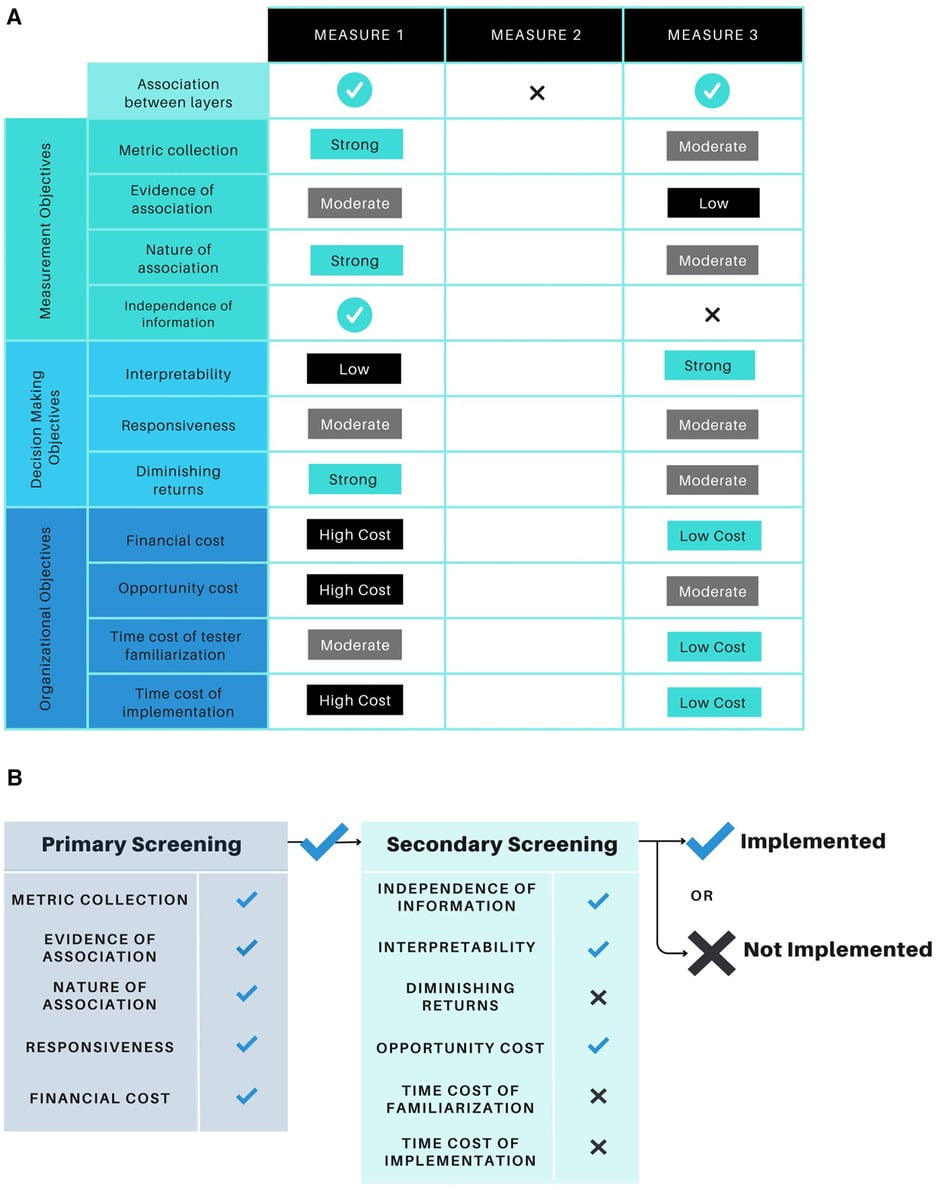
Figure 3
Conclusion
This latest publication presents a scholarly pursuit of establishing evidence-based methodologies that underpin the selection of test measurements critical for the athletic physical conditioning realm. Through meticulous exposition, a novel multilayered construct of validity, subsequently introducing an evaluative framework adept at screening metrics via a tripartite lens – encompassing technical precision, decision-making acuity, and organizational congruence. This intellectual fabrication offers versatility in application, manifesting either as a meticulously organized checklist or as an astute gatekeeping mechanism.
In my humble opinion, the infusion of such methodological rigor in delineating test metrics will be instrumental in transcending conventional physical fitness assessments. By systematically sifting through the extensive arsenal of available measurements, we are not merely streamlining the process but elevating the precision with which we tailor athletic development programs. This, in essence, births a more enlightened pathway towards enhancing sporting excellence, engendered through a judicious blend of scientific inquiry and pragmatic application.
More details are available in the original research publication.
PREPARED BY
Željko Banićević
Ph.D. (c), M.Sc., B.Sc., CPT, PT.
