
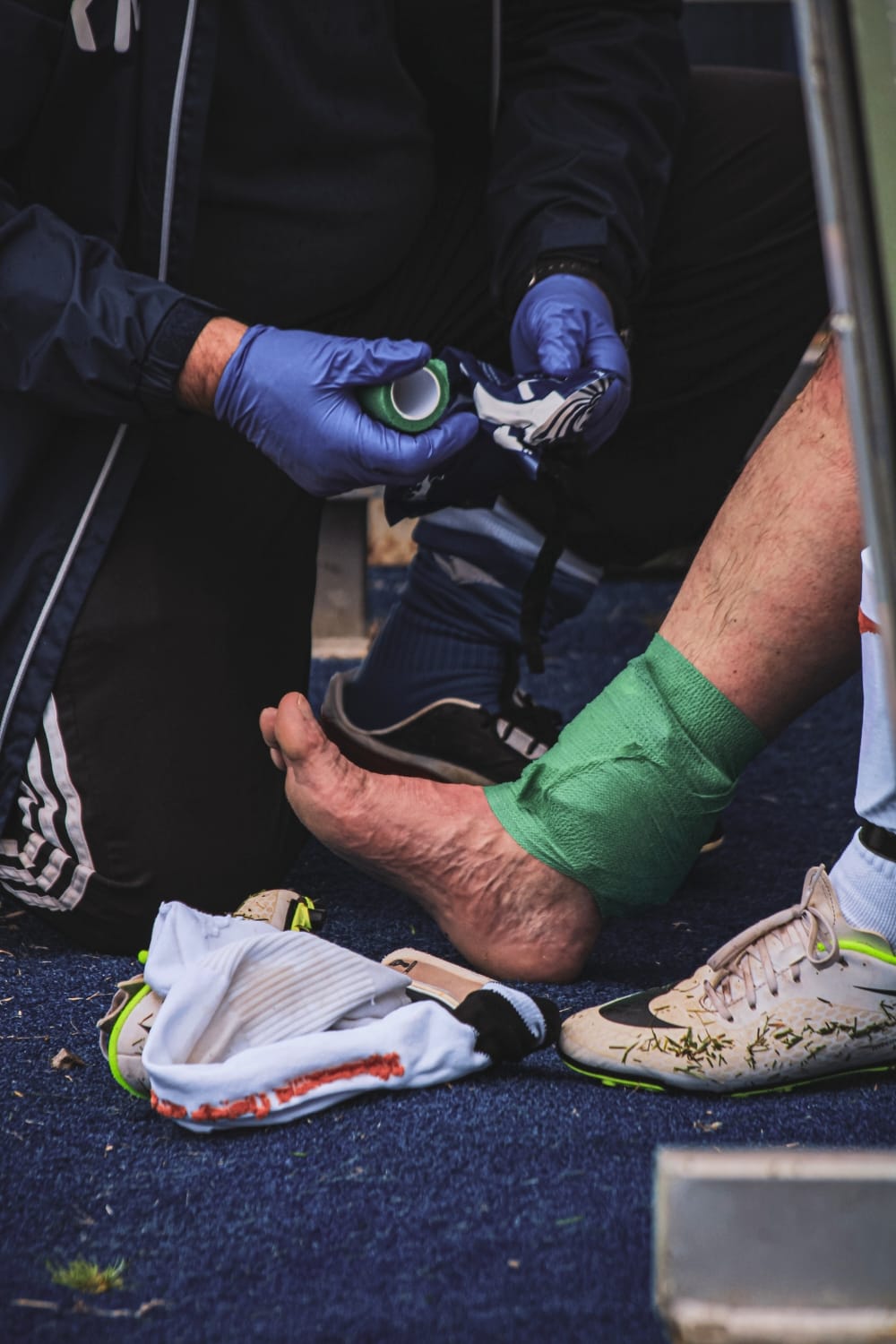
Acute effects of tissue flossing on ankle range of motion in athletes with limited ankle dorsiflexion: A
randomized controlled trial
Authors
Hassan Daneshmandi 1, Mohammad Alimoradi 2,3, Mohammad Alghosi 4, Omid Monfaredian 5, Amirhossein Barati 6, Urs Granacher 7
1 Department of Sports Injury and Corrective Exercise, Faculty of Physical Education and Sport Sciences, University of Guilan, Rasht, Iran.
2 Department of Sports Injuries and Corrective Exercises, Faculty of Sports Sciences, Shahid Bahonar University of Kerman, Kerman, Iran.
3 HERC – Health, Exercise & Research Center, Mina Rashid, Dubai Maritime City, Dubai, United Arab Emirates.
4 Department of Physical Education, Technical and Vocational University (TVU), Tehran, Iran.
5 Department of Sports Biomechanics, Faculty of Sports Sciences, Shahid Bahonar University of Kerman, Kerman, Iran.
6 Department of Sports Medicine and Health, Faculty of Physical Education, University of Shahid Behshti,Tehran, Iran.
7 Department of Sport and Sport Science, Exercise and Human Movement Science, University of Freiburg, Freiburg, Germany.
Phase
Manuscript submitted to BMC Sports Science, Medicine & Rehabilitation
The Project
Abstract
Background:
Restricted ankle dorsiflexion (ADF) is a common impairment in athletes, linked to decreased performance and increased injury risk. Tissue flossing (TF) is an emerging technique proposed to rapidly improve joint range of motion (ROM), though its acute effects on athletes with limited ADF require further investigation. We aimed to evaluate the acute effects of single session TF application on ankle dorsiflexion and plantarflexion ROM in athletes with limited ADF.
Methods:
Forty-four male athletes aged 25.9 ± 4.4 years with ADF-ROM < 10° were randomly allocated to a TF intervention (n=22) or a static stretching (SS) active control group (n=22). The TF intervention used a standard figure-of-eight bandaging technique with 50-70% overlap. While wrapped on both legs, participants performed 3 sets of ankle pumps, squats, and lunges. The SS group performed 3×30 s stretches for the gastrocnemius and soleus muscles on both legs. Dorsiflexion and plantarflexion ROM were measured on the dominant and non-dominant leg at baseline, immediately post-intervention, and 1-hour after post-tests (follow-up).
Results:
Significant group-by-time interactions were found for dorsiflexion ROM in both limbs (all p < 0.001; d = 0.37-0.43). Post-hoc tests revealed that TF produced significantly greater acute effects on dorsiflexion ROM (dominant side: p < 0.001; d = 1.57, non-dominant: p < 0.001; d = 1.52) compared to SS (dominant side: p = 0.020; d = 0.53, non-dominant: p < 0.001; d = 0.33), with trivial to small but significant gains retained for TF at follow-up (dominant side: p = 0.018; d = 0.25, non-dominant: p = 0.005; d = 0.11). Moreover, a significant group-by-time interaction was found for plantarflexion ROM in dominant side (p < 0.001, d= 0.44). Post hoc tests revealed that TF demonstrated significantly greater effects (p < 0.001, d= 0.62) compared to SS (p < 0.001, d= 0.30), with trivial but
significant gains retained for TF at follow-up (p < 0.001, d=0.07).
Conclusions:
A single session TF application appears more effective than SS to improve dorsiflexion ROM in athletes with limited dorsiflexion, making it a time-efficient passive intervention for athletic warm-ups.